
Remembrance
Remembering the Victims of Forced Labour
Victims of forced labour in Witten, 1940–1945
During the Second World War, the town of Witten in the south-eastern Ruhr region became a site of exploitation under the National Socialist regime. Up to 25,000 people from many countries were forced to work here. The majority of the workforce in local industry consisted of these men and women, who were primarily deployed in armaments production.
In 1944, a subcamp of Buchenwald concentration camp was established at the Annener Gussstahlwerk (part of Ruhrstahl AG) to house concentration camp prisoners for forced labour.
A Long Period of Silence
Suppressed and forgotten
For decades after 1945, the fate of the forced labourers and the existence of the subcamp were largely suppressed and forgotten in Witten and across Germany. Systematic examination of National Socialist forced labour only began in the 1980s. In Witten, this chapter of the town's history remained largely unaddressed during the first four decades after the war.
Many former forced labourers returned to Witten in the immediate post-war years seeking information and justice. Their efforts were mostly met with silence. The local population was either unwilling or unable to confront this dark period. As historian Dr. Ralph Klein, who has extensively researched forced labour in Witten, concluded: "Everyone knew."
The forced labourers and camp inmates were a visible presence in everyday town life. They walked the approximately 600-metre route from the camp to the main gate of Ruhrstahl AG on Stockumer Straße — right in the centre of the district, near the railway station, market square, churches, post office, and school.
Despite this, there was no public discussion for many years. The few official actions taken were limited to judicial proceedings against individual camp leaders. From the summer of 1945, the former camp barracks were repurposed — with municipal approval — as a kindergarten. Over time, the buildings were gradually demolished, and the site was partially redeveloped with housing and parking spaces.
The Culture of Remembrance Develops
Public remembrance begins
It was not until 1984 that a research project by Year 10 students at the Albert Martmöller Gymnasium brought the topic back into public consciousness. In response, the town of Witten erected a memorial plaque at the former camp site to honour the victims.
“From September 1944 to April 1945, a subcamp of Buchenwald concentration camp was located here. This memorial is dedicated to the memory of the people imprisoned here and serves as a reminder of the crimes committed against them.”
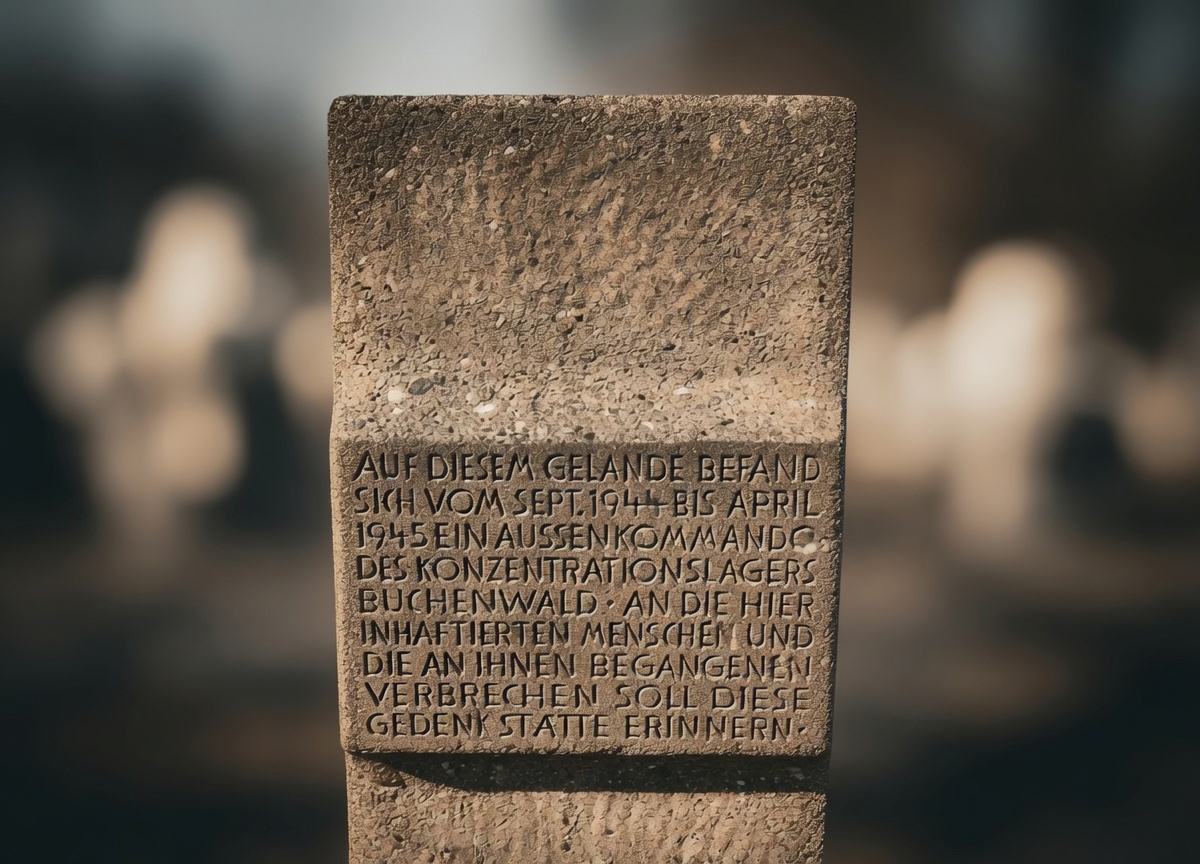
In 2013, two additional information panels were installed, providing further details on forced labour under the National Socialist regime in Witten. The remaining open area of the former camp site was designated a protected site of historical interest in 1992.
We remember those who suffered and perished. Their history is part of our responsibility.