
In Memoriam
The Day the Sky Betrayed Roma
A detailed account of the sinking of Italy's flagship battleship by Fritz X
September 9, 1943, stands as one of the darkest and most tragic days in the long history of the Italian Regia Marina. On that afternoon, in the clear waters of the Tyrrhenian Sea west of Sardinia, the battleship Roma — the pride of the Italian fleet and one of the most advanced capital ships of her time — was sent to the bottom in a sudden, violent attack that highlighted the shifting nature of modern warfare.
01 — Strategic Context
Armistice and Operation Achse
In early September 1943, following the Allied landings on the Italian mainland and the collapse of Mussolini's regime, Italy secretly signed the Armistice of Cassibile on September 3. The armistice was publicly announced on September 8. Under its terms, the Italian armed forces were to cease fighting the Allies and turn over their weapons and bases.
For the Regia Marina, this meant sailing its major warships out of Italian ports to designated Allied harbors — primarily Malta — to prevent them from being seized by German forces. On the evening of September 8, a powerful Italian squadron quietly departed La Spezia under the command of Admiral Carlo Bergamini aboard the battleship Roma.
The fleet consisted of the battleships Roma (flagship), Italia (formerly Littorio) and Vittorio Veneto, multiple heavy and light cruisers, and a screen of destroyers. The Germans, fully aware of the armistice and determined to prevent the handover of the Italian fleet as part of Operation Achse, launched an immediate aerial response.
02 — The Attackers
Dornier Do 217 bombers of KG 100
Fifteen twin-engine Dornier Do 217 K-2 bombers from III Gruppe / Kampfgeschwader 100 (KG 100) "Wiking" carried out the mission. These aircraft were specially modified and crewed by highly trained personnel experienced in guided weapon operations. They approached the Italian squadron from high altitude, staying largely beyond the effective range of the fleet's anti-aircraft guns.
Many Italian sailors initially mistook the approaching German planes for friendly Allied aircraft that had been promised to provide air cover for the transit. This tragic misidentification gave the attackers a critical advantage.
03 — The Strike
A precision guided weapon
Around 15:30 on September 9, the Dornier bombers released their payloads: the advanced radio-guided weapons known initially as the Fritz X, Ruhrstahl SD 1400 X, Ruhrstahl PC 1400X, and FX-1400. From that moment forward, they would forever be remembered simply as the Fritz X.
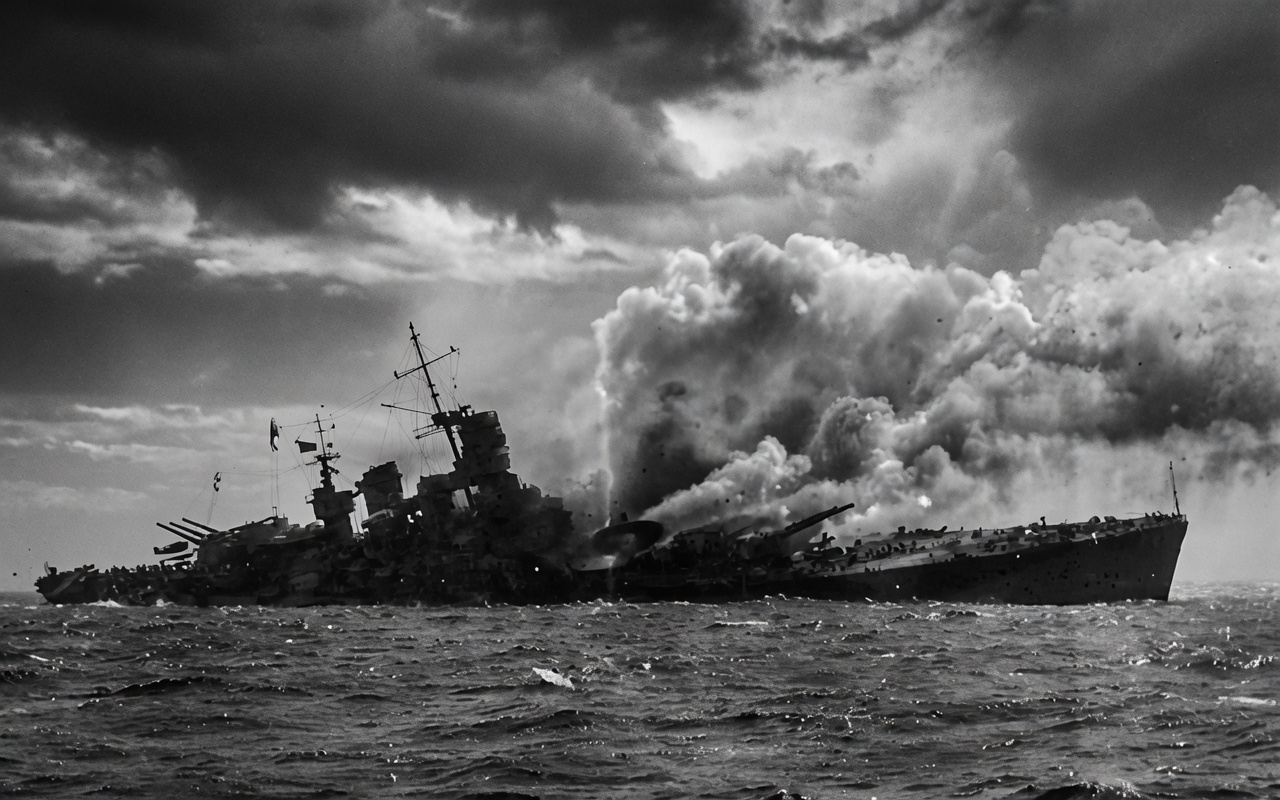
The first Fritz X struck Roma toward the stern, causing significant damage but not immediately disabling the ship. A second Fritz X then scored a direct hit near the second forward main turret (B turret). The weapon penetrated the armored deck and detonated deep within the ship, in or near the forward ammunition magazine.
04 — The Catastrophic Explosion
Instantaneous and apocalyptic
The results were instantaneous and apocalyptic. The detonation of the battleship's own stored 381 mm shells and propellant charges created a massive internal explosion. The blast:
- Completely destroyed the forward magazine area
- Lifted the entire 1,000+ ton triple 381 mm gun turret off its mounting and hurled it into the sea
- Shattered the hull girder and internal bulkheads
- Triggered uncontrollable flooding and secondary fires
Roma began listing heavily to starboard. Within minutes she broke in two. The stern section sank first, followed by the bow, which drifted briefly before also plunging into the depths. The once-mighty battleship disappeared beneath the waves in less than 30 minutes.
05 — Human Cost
1,352 sailors lost
Of the 1,974 men aboard Roma, 1,352 lost their lives, including fleet commander Admiral Carlo Bergamini and many senior officers and experienced crew.
Only 622 survivors were rescued from the water. The sister ship Italia was also damaged by a Fritz X during the same engagement but reached Malta. The remainder of the squadron arrived safely at Allied ports.
06 — Technical Highlights
Battleship Roma — key specifications
- Class
- Vittorio Veneto (Littorio-class)
- Displacement
- 43,845 tons (full load)
- Length
- 236.2 m (775 ft)
- Beam
- 32.3 m (106 ft)
- Draft
- 9.3 m (30.5 ft)
- Propulsion
- 4 steam turbines, 8 Yarrow boilers, 138,035 shp
- Maximum speed
- 30 knots
- Main armament
- 3 × triple 381 mm (15-inch)/50 caliber guns
- Secondary
- 4 × triple 152 mm guns
- Anti-aircraft
- 12 × twin 90 mm, 20 × twin 37 mm, 32 × 20 mm
- Complement
- 1,974 officers and men
- Builder
- Cantieri Riuniti dell'Adriatico (CRDA), Monfalcone
- Commissioned
- June 1942
07 — Legacy and Discovery
A protected war grave
The sinking of Roma was more than the loss of a single ship. It symbolized the painful fracture of the Axis alliance and the high human cost of Italy's abrupt change of sides. It also served as a dramatic demonstration of the power of precision-guided munitions against even the most heavily armored warships.
The wreck of Roma was located in 2012 by Italian engineer Guido Gay and his team using the advanced underwater vehicle Pluto Palla. The site lies at a depth of approximately 1,000 meters, about 16 nautical miles off the coast of Sardinia 41°9′28″N 8°17′35″E (≈41.15778°N 8.29306°E). The hull is broken into large sections, with the massive turrets scattered across the seabed. It is now a protected war grave.
"Mamma Mia…"
A simple, emotional exclamation that continues to capture the sorrow felt by generations of Italians when they remember this day.
Eternal rest to Admiral Carlo Bergamini and every sailor who went down with the battleship Roma. May their sacrifice never be forgotten.
Lest we forget.