
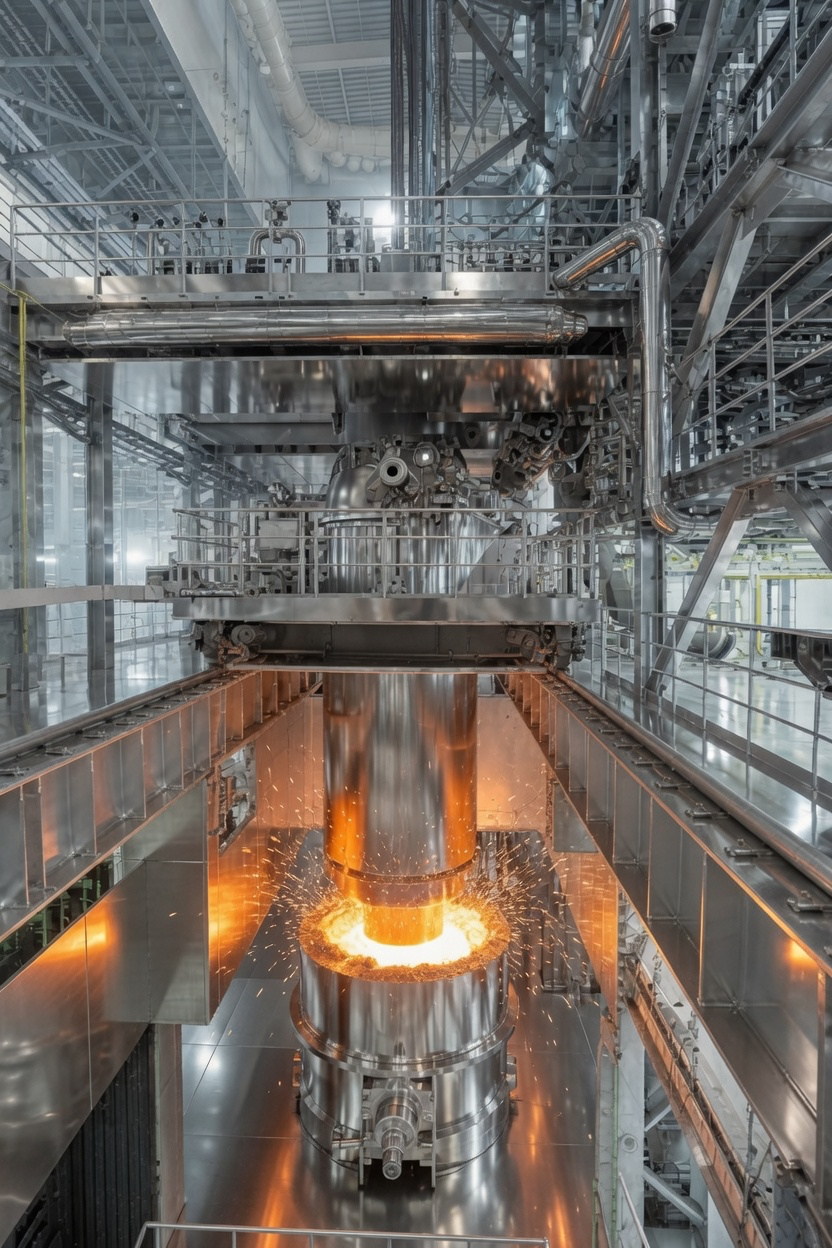
Main purpose
- Remove dissolved gases (especially hydrogen and nitrogen)
- Decarburize the steel to very low carbon levels (down to <10–20 ppm)
- Improve cleanliness (remove inclusions)
- Homogenize temperature and composition
- Allow precise alloying additions under vacuum
Core principle
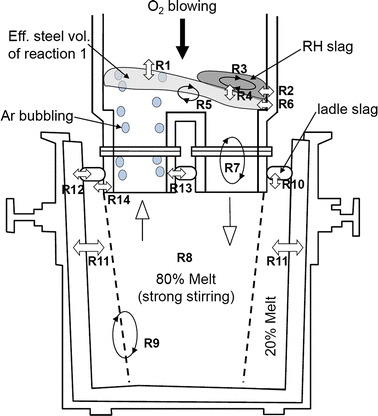
Vacuum recirculation process. Two snorkels are immersed in the ladle. Argon is injected into the up-leg, creating a gas-lift effect that continuously circulates steel into the vacuum vessel and back down the down-leg. Degassing and refining occur under deep vacuum.
Key operating parameters
Typical industrial values
Heat size
100–400 t
Vacuum level
0.5–5 mbar (often ~0.67 mbar)
Steel circulation rate
85–150 t/min
Treatment / cycle time
15–30 min
Oxygen blowing (RH-OB)
2,000–4,000 Nm³/h
Snorkel diameter
~500–700 mm (e.g. 650 mm common)
Argon lift gas
Continuous injection in up-leg
Vessel preheat
900–1,500 °C
Barometric rise height
~1.45 m under deep vacuum
Main metallurgical functions
- Ultra-low carbon: routinely < 20 ppm (sometimes < 15 ppm)
- Hydrogen removal: < 1–2 ppm
- Nitrogen removal
- Inclusion flotation and cleanliness improvement
- Precise alloying under vacuum
- Chemical heating via oxygen blowing (exothermic C–O and Al–O reactions)
- Optional powder injection for deep desulphurization (in advanced RH-TOP units)
Where the reactions happen
- Free surface of the steel bath inside the vacuum vessel
- Surfaces of rising argon bubbles
- Splashed / atomized steel droplets in the vessel
- Bulk steel in the strongly stirred zone of the ladle
- Interface with the RH slag layer
Process sequence
- Vessel preheated → ladle positioned
- Snorkels immersed → argon injection starts
- Vacuum applied → steel rises and circulates
- Oxygen blowing (if RH-OB) for forced decarburization and heating
- Alloy additions via vacuum hoppers
- Final vacuum hold for gas removal
- Snorkels raised → ladle transferred to casting
Advantages vs. other vacuum processes
- Very high circulation rate → short treatment times even for large heats
- Excellent mixing independent of ladle size
- Minimal temperature loss
- High productivity (long sequences of ultra-low-carbon grades)
- Flexible (pure degassing, or RH-OB / RH-TOP with oxygen and powder)